The state of fraud in 2026
Poor quality completes are growing while AI-assisted fraud adapts.
The multi-signal framework
Pre-survey entry signals meet in-survey behavioral checks.
Testing on 11,778 respondents
Different checks catch different respondents.
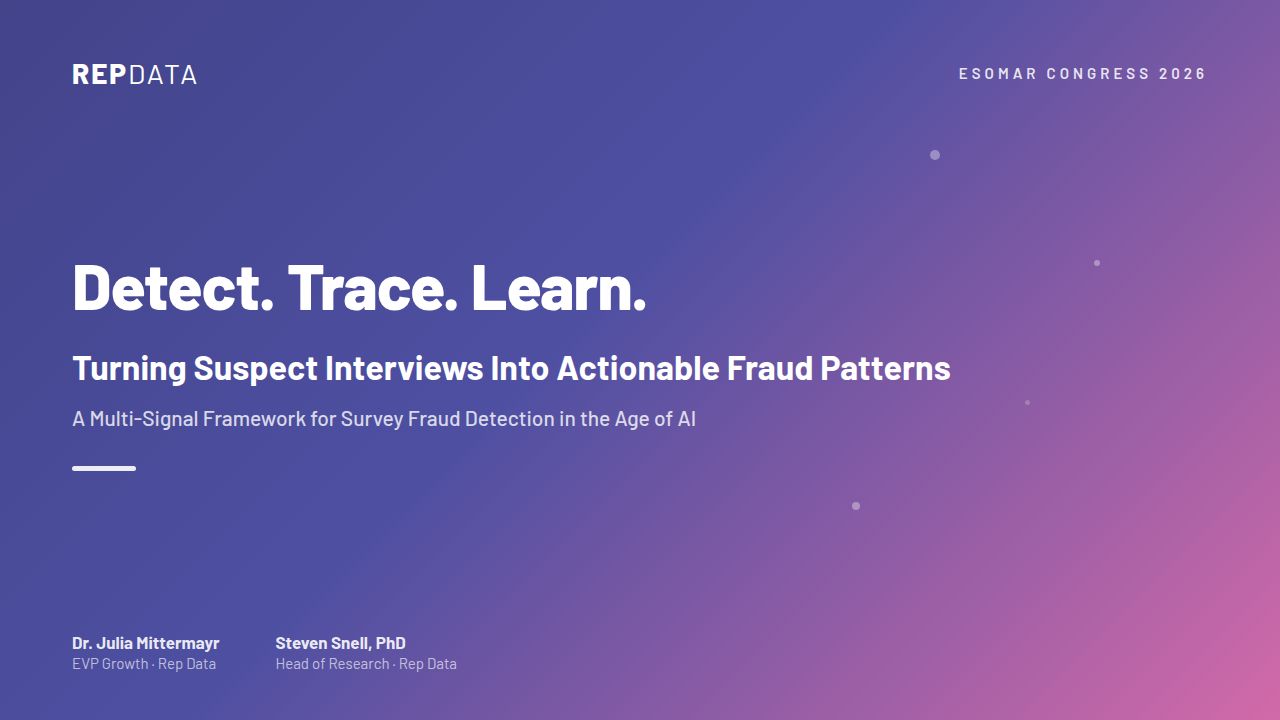
ESOMAR 2026 Research Brief + Slides
Does Fraud Have a Pattern?
Julia Mittermayr and Steven Snell examine what happens when pre-survey defense is combined with in- and post-survey behavioral quality layers across more than 11,000 respondents. They trace flagged cases back to the first click to test whether fraud archetypes emerge and whether early behavior predicts what happens during the survey.
Get both resources
Fill out the form and both downloads unlock instantly.
Inside the research brief
What the study found
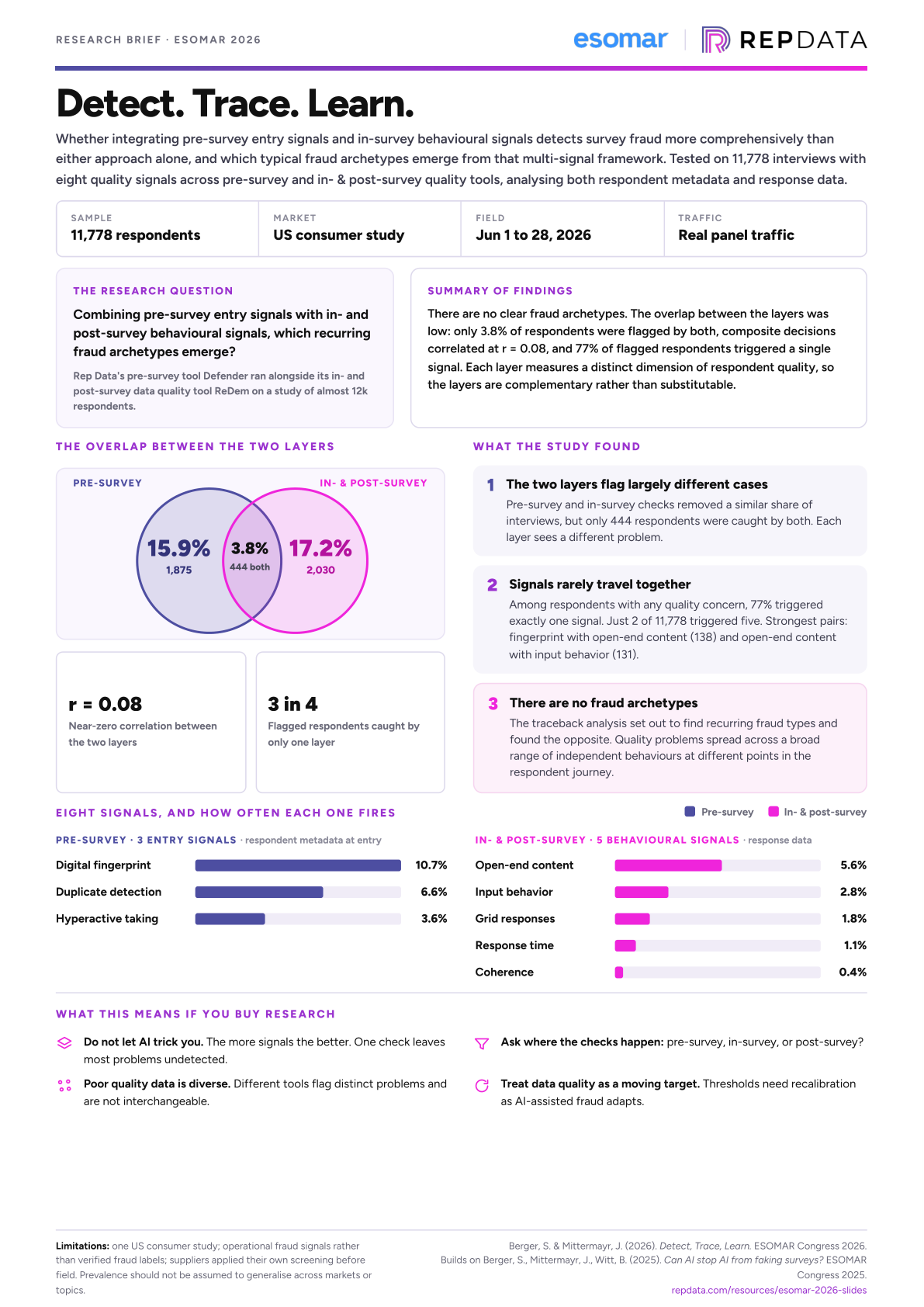
The brief brings the core findings into one visual summary before the deck walks through the research and the framework behind it.
The research question
Do recurring fraud archetypes emerge when pre-survey entry signals are combined with in-survey and post-survey behavioral signals?
The two layers flag different cases
Pre-survey and in-survey checks removed a similar share of interviews, but each layer caught a different set of respondents.
Signals rarely travel together
The two layers had near-zero correlation, showing that one check leaves most problems undetected.
There are no fraud archetypes
The study found recurring problems spread across a broad range of independent behaviors rather than a few distinct respondent types.
Eight signals tell a fuller story
Three pre-survey entry signals and five in-survey behavioral signals each identify different dimensions of respondent quality.
What this means for buyers
The more signals the better. Buyers should ask where checks happen and treat data quality as a moving target as AI-assisted fraud adapts.
Inside the slide deck
Six parts, from live AI fraud to buyer takeaways
The session opens with a game of spot the AI, moves through the state of fraud in 2026, then puts an eight-signal framework to the test on a real US consumer study and closes with what the results mean for anyone buying research.
Part 01
Spot the AI
Could you tell the human from the agent?
- Two open ends, one real respondent and one AI agent
- The metadata that separates them
- Hyperactivity, duplication, and tech enablement
- A playground link so you can test yourself
Part 02
The state of fraud in 2026
What changed in twelve months?
- 80% growth in poor quality completes
- Open ends are the top removal reason
- Half of open-end exclusions are AI-suspect text
- 141% growth in AI-suspect terminations in six months
Part 03
Where we left off at ESOMAR 2025
Can AI stop AI from faking surveys?
- Five attack stages, from simple bots to agents with personas
- A static defense against a dynamic attacker
- Why last year's answer was incomplete
Part 04
The multi-signal framework
What does a layered defense look like?
- Three pre-survey entry signals
- Five in-survey and post-survey behavioral signals
- Respondent-level and response-level checks combined
Part 05
Testing on 11,778 respondents
Do fraud archetypes exist?
- 15.9% flagged pre-survey, 17.2% in and post survey
- Near-zero correlation between the two layers
- Roughly 3 in 4 flagged respondents caught by only one layer
- Fraud is heterogeneous, with no distinct archetypes
Part 06
What it means for buyers
How should this change the way you buy research?
- The more signals the better
- Treat data quality as a moving target
- Ask where the checks happen
- Different tools flag distinct problems
Want the research brief and slide deck?
Start with the research brief, then go deeper with the full ESOMAR 2026 slide deck. Complete the form to get both resources.
Get both resources