Professional Survey Takers Are Real. Here's What They Do to Your Data.
Rep Data Team · November 20, 2026 · 6 min read
Some in market research will tell you professional survey takers are a myth. Our data says otherwise.
Professional survey takers are part of a longer list. RepData's Verified Intelligence Platform scans for eight serious threats to research data:
Inattentive respondents: speeding, straightlining and inconsistent responses.
Cheaters: using AI or copy/paste to answer questions.
Hyperactive respondents: an unusually high volume of survey activity.
Yea-sayers: over-claiming to get into more surveys.
Device-based fraud: manipulated, spoofed or masked device data.
Suspicious tech: developer tools and other technology associated with fraud.
Bots: automated scripts taking the survey.
AI agents: LLM agents posing as respondents.
This post is about the uncomfortable part of this list: the real people. Some are outright fraudsters. Some are simply very, very good at qualifying. Either way, they look legitimate from inside any one survey, which is exactly why they're so easy to miss.
And they're not rare. We've seen individual devices attempt 50, 100, even more than 1,000 surveys in a single 24-hour period. The highest count we've observed is 1,178. Respondents attempting 200 or more surveys showed up in every sample source we examined.
Only half your sample is both real and paying attention
In RepData's analysis of who enters a typical online study, one in three entrants is fraudulent. And most of that fraud isn't sloppy.
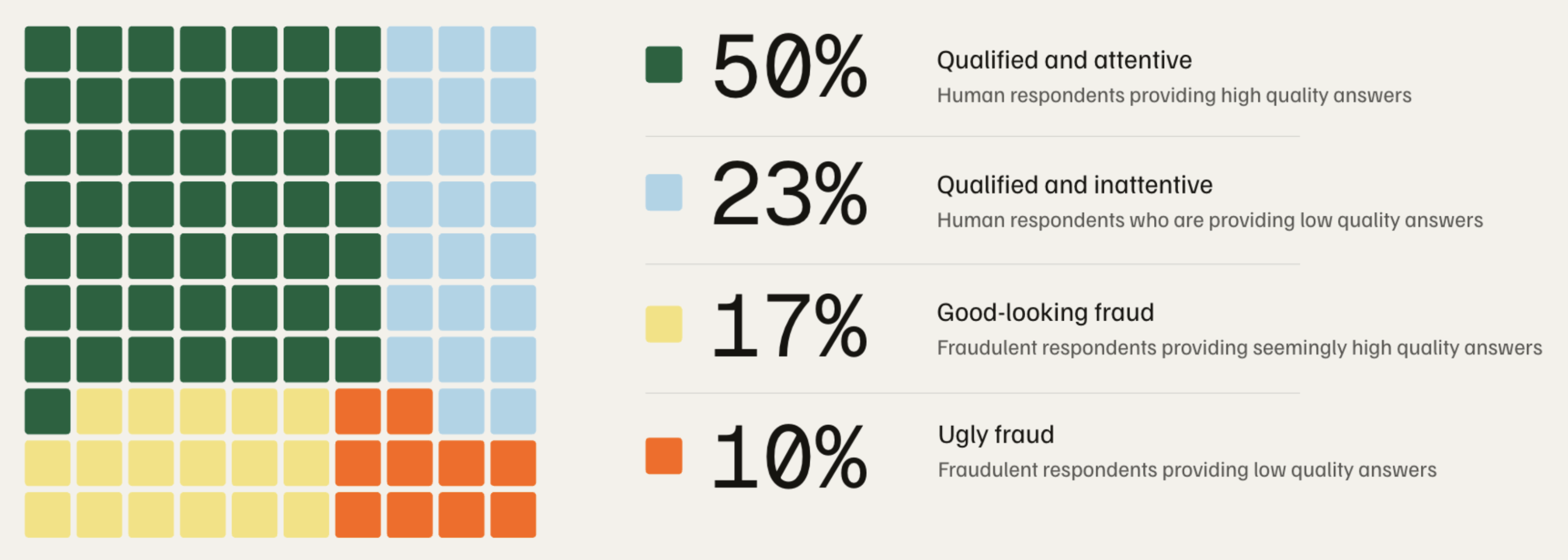
That 23% is the number to pay attention to. These respondents answer questions carelessly, type out plausible open-ended responses, and sail past the speeder and straightliner checks built into your survey tool. If you only look at the answers, they look like your best respondents.
The yea-sayers: The people who've learned to qualify
Hyperactive respondents and yea-sayers are the heart of the problem, and the hardest to see.
A hyperactive respondent isn't necessarily a fraudster. They're someone who has learned what it takes to get in. They agree with almost every statement, claim to own every product, and say they plan to buy almost anything. That's a yea-sayer's playbook: over-claim at the screener, unlock the next study, repeat.
The result is positivity bias. Your concept tests look better than they should, purchase intent runs hot, and nothing inside the study reveals why, because each respondent looks perfectly reasonable in isolation.
The numbers show how widespread it is. Median survey attempts per device in a 24-hour window ranged from 6 to 33 depending on the source.
The catch is that you can't see this from inside one panel. Cross-panel over-participation only shows up to a system that watches the whole ecosystem at once. When a single device arrives from Panel A, Panel B and Panel C in the same hour, that's a pattern. Each panel, looking only at its own slice, sees a perfectly normal member. RepData scans more than 15 million sessions a day across 250+ panels, marketplaces and direct supplier feeds, at least ten times the visibility of the next-largest fraud detection tool in research. That's how we can see it, and how we know these respondents are real.
Cheaters and impostors: fraud that looks like good data
The other human threats work differently. They're not gaming the screener so much as gaming the system.
Cheaters use AI or copy/paste to answer open-ended questions. The respondent is real, but the words aren't theirs. Impostors go further, hiding who they are: device-based fraud means manipulated, spoofed or masked device data, and suspicious tech means developer tools and other technology associated with fraud.
These techniques are cheap and widely shared. A fraudster can route through a commercial VPN or a low-cost mobile proxy network to appear somewhere they aren't. They can run an emulator so one desktop presents as a dozen different phones, each with its own fingerprint. They can open developer tools to read and manipulate the survey's own traffic.
And it's moving fast. Between January and June 2026, monthly detections of emulated devices rose 46%, and detections of browser automation rose 56%. Developer-tool detections appeared as a new category, reaching 4,482 a month by June. In market research, once someone figures out how to exploit a survey, the technique spreads quickly.
The cost isn't only wasted spend, though every fraudulent complete is one you paid for. Fraudsters systematically understate awareness of well-known brands, which flattens real differences and creates the illusion that your brand and your competitors are indistinguishable.
The ones you already know: machines and inattention
The remaining three threats will be familiar. Bots are automated scripts taking the survey, and AI agents are LLM agents posing as respondents. Inattentive respondents speed, straightline and contradict themselves.
AI-driven fraud is getting more capable, so detection has had to keep pace: signals for cloud-based LLM environments were added as that fraud became operational, and a hidden honeypot question catches bots that fill in what no human can see. Inattention, meanwhile, is mostly a genuine-respondent problem: it accounts for 27% of entrants, and it's the kind of low-effort data that careful cleaning does catch.
Why cleaning alone won't save you
The usual answer to bad respondents is to clean them out afterward. We tested whether that works.
In a series of passive-mode studies, every respondent was scored and flagged, but nobody was blocked. Then the data went through a rigorous, ML-powered, human-supervised cleaning process, the kind a careful research team would run.
It missed 69% of the fraud we had already flagged (679 flagged respondents). For fraud flagged on hyperactivity alone, cleaning still missed 51%.
The reason is simple. Cleaning inspects the answers: straightlining, speeding, contradictions, thin open ends. Our checks inspect the respondent: the device, the network path, the browser environment, and behavior across the wider ecosystem. A motivated fraudster on a VPN and an emulator produces answers that look fine and a technical fingerprint that doesn't. A genuine but distracted respondent produces the opposite. Each approach is blind to the other's problem, so you need both.
Cleaning catches low-effort humans. Prevention catches motivated fraud.
So we built a system that learns
No single check catches all eight threats, so the Verified Intelligence Platform doesn't rely on one. Checks before and during the survey teach each other.
Curated sources. Panel sources are chosen based on their historic quality performance.
Pre-survey checks. Every respondent is evaluated on the way in, for signals like hyperactivity and VPN use.
Extra scrutiny. Anyone flagged pre-survey, even if not blocked, gets closer inspection from the in-survey checks.
In-survey scoring. Every response is scored on five criteria, and a machine learning model learns from everything captured on that respondent.
Feedback. Those results sharpen the next pre-survey evaluation. The platform also tracks which sources flagged or blocked respondents come from, and can block a source that sends too many.
The point of the loop is that each survey makes the next one cleaner, and it keeps up with threats that change faster than any fixed rule list.
What's left: only real, attentive people
Scan for all eight, remove what the scan finds, and what remains is what your research should have been built on from the start.
The connected Verified Intelligence Platform, including the full quality suite, is available late January 2027. Want to see what the scan would catch on your own studies? Talk to our team.